

个人简介
杀害班花逃15年


推荐博文
花样男子
2026-08-26
分类: 天眼查
花样男子
4,220-year-old rock art in SW China’s Yunnan reveals early cultural links with Southeast Asia_我的网站

一 | 快讯摘要 新三板基础层公司昊诚锂电大宗交易折价16.58%,成交金额484.96万元 每经讯,2026年8月24日,新三板基础层公司昊诚锂电(873892,收盘价:9.59元)发生一笔大宗交易,成交价8元/股,成交数量60.6... 快讯正文新三板基础层公司昊诚锂电大宗交易折价16.58%,成交金额484.96万元 每经讯,2026年8月24日,新三板基础层公司昊诚锂电(873892,收盘价:9.59元)发生一笔大宗交易,成交价8元/股,成交数量60.62万股,成交金额484.96万元,折价16.58%。买入营业部是招商证券股份有限公司武汉航空路证券营业部,卖出营业部是招商证券股份有限公司武汉航空路证券营业部。
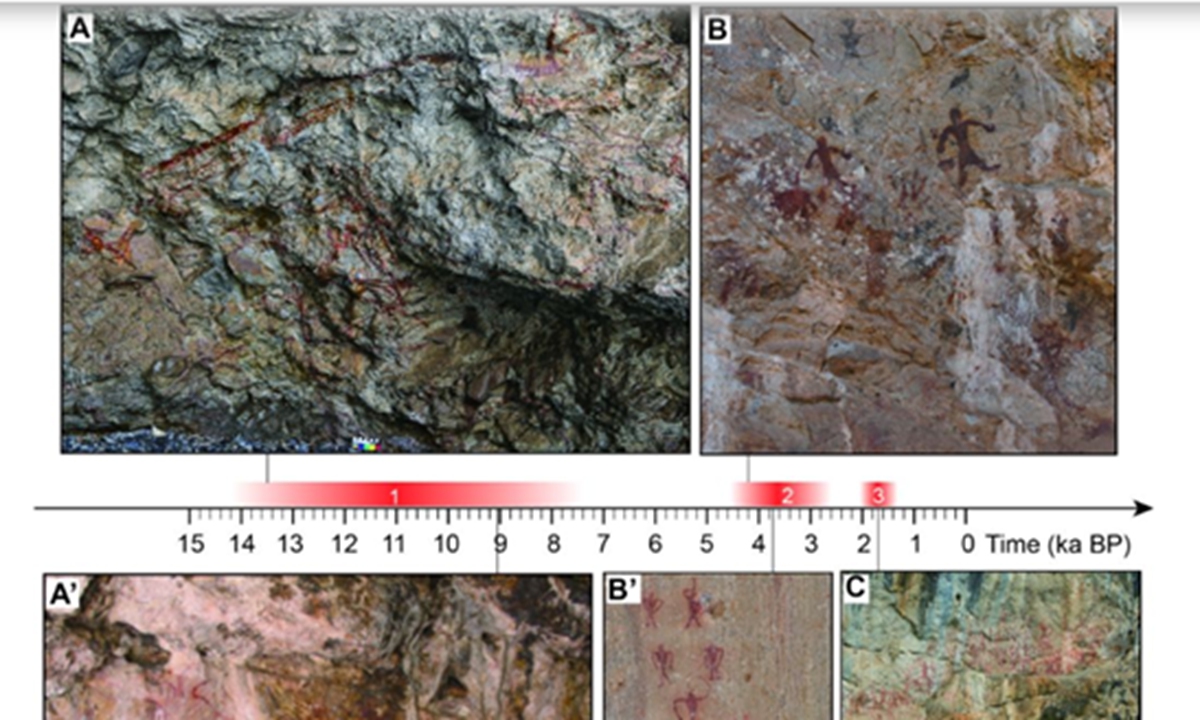
Chinese researchers have obtained the first absolute dates for rock paintings at the Mangguan rock art site in Southwest China's Yunnan Province, pushing the known history of rock art created by prehistoric settled communities in the region back to about 4,220 years ago. The paintings also suggest cultural interactions more than 4,000 years ago between Southwest China and civilizations along the Yellow and Yangtze rivers, as well as possible exchanges with neighboring parts of Southeast Asia, including present-day Myanmar, Thailand and Vietnam, a member of the research team told the Global Times.
The Yunnan Provincial Institute of Cultural Relics and Archaeology, in collaboration with Nanjing Normal University and other institutions, have recently made a significant archaeological breakthrough. Through systematic surveys and uranium-thorium (U-Th) dating at the Mangguan site in Gengma county, the research team obtained the first absolute dates for the site's rock paintings, tracing rock art created by prehistoric settled communities back to around 4,220 years ago.
The findings were recently published in the international journal Journal of Archaeological Science: Reports.
The Mangguan rock paintings represent one of the best-preserved prehistoric rock art sites in Yunnan. The research team presented high precision U Th dating of carbonate accretions that stratigraphically overlie the painted motifs at the Mangguan site, according to the paper published in the journal.
The dating results show that carbonate deposits overlying a human figure yielded a corrected age of 4,240 ± 19 years before present, confirming that ancient people living in the region had already produced mature figurative art at least 4,220 years ago, Wu Yun, first author of the paper and an associate researcher at the Yunnan Provincial Institute of Cultural Relics and Archaeology, was cited by the Xinhua News Agency report as saying.
Dating results from 11 samples taken from different motifs clustered between about 3,907 and 3,056 years ago. By comparison, the Cangyuan cliff paintings had previously been dated to roughly 3,800 to 2,700 years ago. The Mangguan paintings are therefore significantly older, filling an important chronological gap in the region's artistic record before the Cangyuan phase.
Shao Qingfeng, corresponding author of the paper and a professor at the School of Geography at Nanjing Normal University, told the Global Times that previous estimates dated the Mangguan rock paintings to a little over 3,000 years ago based mainly on imagery and comparisons with similar regional sites. Using microsamples of secondary carbonate deposits overlying the paintings, researchers have now obtained a precise minimum age of about 4,220 years before present without damaging the rock art.
The findings and the establishment of this chronological framework not only strengthen the archaeological foundation for studying rock art in Southwest China, but also provide a direct reference for rock art sites across Southeast Asia that have yet to undergo systematic dating, Shao said.
The findings may also challenge long-held perceptions of Southwest China around 4,200 years ago - roughly the era of the Xia Dynasty (c.2070 BC-C.1600 BC) - and help fill a key gap in understanding the pluralistic yet integrated development of Chinese civilization.
Shao said that while academic research has traditionally focused on the Yellow River and Yangtze River basins as cradles of early Chinese civilization, sites such as Mangguan and Cangyuan show that stable and culturally active communities also thrived in mountainous Southwest China. The newly established rock-art chronology brings an artistic dimension to the broader narrative of China's enduring cultural development.
Moreover, stylistic similarities suggest that Southwest China maintained exchanges with the Yellow River and Yangtze River regions and with early societies in Southeast Asia, providing material evidence of cross-regional interaction more than 4,000 years ago.
。 (记者张明双) 免责声明:本文内容与数据仅供参考,不构成投资建议,使用前核实。据此操作,风险自担。 每日经济新闻 。
Current article:http://xljl.cengzaodengchawonin.cyou/news/20260826_5072.html
Published on:06:06:16
相关热门文章
- 杂草坑变小花园 “同心亭”成议事厅
- 西媒:国王杯决赛球场已经为皇马vs巴萨焦点战做好准备
- 广州每日优鲜主要人员变更 此前曾被列入经营异常名单_该公司_名录
- 牛逼!76人又来全明星!退役前再联手詹姆斯
- 售7.88万/共推出1款配置 比亚迪海鸥自在版正式上市
- 美官员称美政府正准备撤销多达20万个商务和旅游签证
- 中国男篮公布亚运大名单!周琦+杨瀚森落选 上届爆冷不敌菲律宾
- 冲突再度升级,为何股市还逆势修复走强?
- A股三大指数集体收跌,全市场超3900股下跌
- 7月中国核发绿证3.06亿个,7月中国核发绿证3.06亿个
- Nearly 3,000 job seekers apply at Chinese companies’ recruitment fair in Brazil
- Lisa赴美度假晒泳装照 黑色比基尼尽显火辣身材
- 黄章:美祖16S的价格比16S高500元左右。
- 黄金站上4400,难道是新一轮上涨开始了?|1222 张博划重点
- 公安机关“夏季行动”“平安护航”专项行动取得阶段性成效


